
Traditional publishing goes something like this:
write book –> revise book –> revise book again –> revise AGAIN again –> decide that you’re finally ready to try getting an agent and maybe publish this thing –> ???

¿¿¿¿¿¿¿??????
For any normal human being, taking that first big step toward publishing can be overwhelming. But don’t worry! It’s me, your local semi-qualified writing gremlin, and I’m here to help demystify this very mystifying process, one step at a time. Today, we’ll be talking about querying.
what is querying, exactly? please help
Querying is the process of sending out query letters and other materials to agents in order to find representation for your FINISHED fiction manuscript. (Non-fiction is a different can of worms.) Your query should distill your book down to a single page while enticing agents to read more. There are specific ways to craft and structure a query, and certain tacit rules that may not be apparent to everyone. Here are a couple of resources that might help you write your letter:
QueryShark
How to Write a Query Letter
38 Query Letter Tips From Literary Agents
QUERY TIME: Hook, Book, & Cook
The problem with querying is that it’s a different road for everyone. The speed or ease with which you find an agent, if at all, is not a reflection on the quality of your book, writing, or self. With all that being said, here’s how it went for me.

my stats
Queried ARI’S GUIDE TO RAISING THE DEAD (YA contemporary fantasy) for approximately four months.
Queries sent: 41
Form Rejections: 17
No Response: 6
Partial Requests: 5
Full Requests: 13
Offers of Rep: 1
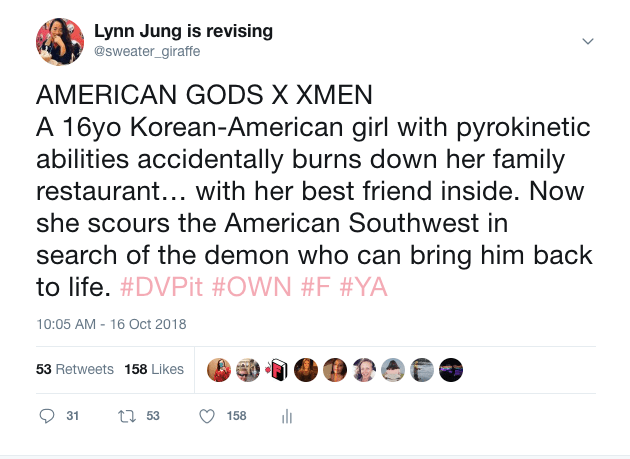
Most of the fulls were due to the fact that I participated in 2 Twitter pitch competitions: the September 2018 #PitMad and the October 2018 #DVPit, the latter of which was what eventually matched me with Kerstin Wolf, my agent.

how do i find agents to query?
The internet is your friend. A cursory Google search will turn up a million different lists; the acknowledgments sections of recent books that match your age group and genre are also a great place to start. Make sure that the agents you query are open to submissions and looking to represent the type of book you’re writing! Don’t just shoot off a million of the same letter at once—take your time and really think about who you’re sending to and why. This also helps you personalize your query to the agent/s in question, which can really make or break you. (Trust me: every time I skimped on personalization, the agent either passed or gave me no response.)
Once you have a decent-sized list of potential candidates, I highly recommend querying in small batches. For me, 8-12 at a time was perfect, because it allowed me to polish up my query based on the rejection feedback and try again. Of course, my system kind of went out the window once I gained some traction through pitch contests, but that was a good thing!
Other resources:
QueryTracker is helpful for tracking agents’ stats. Other querying authors post comments on agents’ pages about how quick response time was, if they offered personalized feedback, and so on and so forth. Also, an agent’s presence on here is a fairly decent litmus test for whether or not an agent is Legit and Not Looking to Steal Your Money and/or Identity and/or Dog.
#MSWL is a website that aggregates tweets using the #mswl tag, which is short for Manuscript Wishlist. Agents will call for specific stories and concepts through this tag, which makes finding strong potential matches a lot easier! You can even mention the hashtag in your query. However, the specificity in this tag does make it difficult to navigate, and finding that perfect match basically boils down to luck.
And, of course, there is Twitter. I hate it Twitter is practically a must for authors in this day and age, and if you’re planning on entering pitch contests, you should have a fairly well-established Twitter presence. Even if that’s not the route you want to go down, Twitter is an invaluable research when it comes to finding agents and stalking them trying to determine if they would be interested in your book. However, you should always do additional research on agents you find through Twitter—you never know.

okay, but what is querying actually like?
Again, the process varies for everyone. Long waits are normal. Lots of rejections are also normal. But if your letter is strong, your premise is marketable, and you’ve done your research, you’re more than likely to get some full and partial requests! This is when the agent asks to see your actual manuscript and see if this is a book they want to represent.
After you send off a full request (or a partial that eventually results in a full) there’s even more waiting. And I’m not going to lie—when an agent rejects you after reading your whole entire book, it stings. Pretty badly. But there’s always a bright side, and in this case, it’s that 8/10 times the agent will give you at least a few lines of personalized feedback on what did and didn’t work for them. You can and should UTILIZE THIS. You’re essentially getting free critique from an industry professional! I compiled all of my agent feedback in one doc and continued to refer to it while revising with my agent, and most of it was 100% correct and helped strengthen my manuscript. Most of it was ‘this is too short.’
Anyway, if all goes well during this stage, you might end up with one of those coveted agent phone calls. And if that goes well, you could even land an offer of representation! Here’s where you go through the whole process of notifying all other agents who have your letter and/or manuscript and start exercising your signin’ hand. But all of that is for another day.

what happens if i can’t get an agent?
If you’ve been querying the same project for a year or two without much success, take a moment to pause and determine what about your approach isn’t working. Is your query falling flat? Are you getting requests, only for the agent to eventually turn the manuscript down? Have you been taking agent feedback seriously and making the requisite changes? Is it a steampunk dystopian vampire romance book with a magical boarding school? (If so, maybe…. maybe don’t.)
After a certain amount of time, you may have to shelve the project and write something else. Maybe you’re just not at the level you need to be to tell that story yet. Maybe the market isn’t where it needs to be, or the right agent hasn’t come onto the scene—just take some time away and be creative again. It’s so easy to forget what we’re here for once we get caught up in the dizzying cycle of rejections and near-misses, so take some time away.

cool. what else do i need to know?
My top tip for querying is to keep the flow going. I know it’s difficult not to take things personally as an author, but you kind of have to put your blinders up, or at the very least grow accustomed to the sting of rejection. What I did was set a rejection goal: my plan was to reach 100 rejections before the end of the year, which I obviously didn’t hit, but it gave me something to do other than wallow in self pity once the no’s started coming in. Always have another task in place, another thing to focus your energy on. Learn to pick yourself up and keep going. Momentum is key.
Finally, be patient and kind. Don’t take rejection personally, and definitely don’t respond to rejections in a flurry of self-aggrandizing indignation, talking about how the agent just made the biggest mistake of their life and they’ll rue the day, blah blah blah. Just take a deep breath and move on. You only need one yes.
xx

 lynn d. jung
Leave a comment