
Next: Revise With Me: How I’m Fixing My YA Fantasy (Part II)
Today’s thing is going to be a little bit different. My monthly updates are kind of not happening (there’s nothing to say other than my hours got increased, my classes are a mess, and yes, I’m tired all the time, how about you?) so I figured this might be a bit more manageable for me. And relevant for my blog readership, which I’m pretty sure is composed entirely of high school friends who don’t write but want to support me.
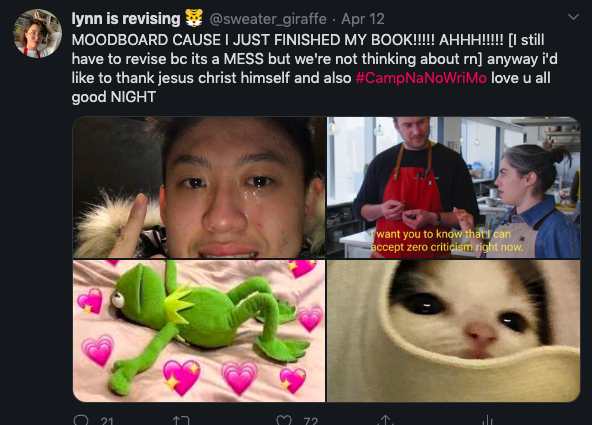
Getting to the point: on Easter I miraculously finished drafting a book. Here is my heat-of-the-moment tweet as Exhibit A:
The project is a Korean-inspired fantasy that clocks in at just under 90k. The draft I’ve just finished is my fourth draft in a year and a half. Originally, it was my NaNoWriMo book for 2018, so this has been a long time coming.
In any case, I thought it might be interesting to document how I approach revisions for a specific project. For me, every book is different, and even though I outlined my basic revisions approach in this post I’ve realized my revising methods are pretty nebulous. So, yeah, welcome to my revisions diary.

part one: letting it sit
The week after I finished drafting, I did two things: I sent my book off to two trusted alpha readers and I played video games until my brain leaked out of my ears. My readers live-texted me their reactions and I jotted down notes here and there, but I didn’t touch the draft.
Normally I either wait longer or don’t wait at all, but I think a week was a pretty good sweet spot for this book. It gave my readers time to finish up and send over their thoughts, and I was able to mindwipe myself effectively enough, too. I think it helped that I made it a point not to go back and endlessly reread what I’d written while I was drafting.
part two: blind brainstorming
For about three or four days, I picked my readers’ brains and started coming up with big picture revisions. Stuff like character development moments, goals, and other plot points I wanted to add, remove, or alter. I’m an extroverted thinker, so I like to bounce ideas off of another person as much as possible. Which in these days, means lots of late-night Facetime calls. But I still wasn’t really ready to open up my mess and see what I’d actually written, so I worked off of my own memory and whatever my readers were saying.
From there, I started to make a plan. Essentially, at this stage I was trying to fix the main plot of the book. If you’re familiar with Blake Snyder’s beat sheet, I was fixing my beats to unify the story I’d set out to write with the story I had actually written. (I’m fully aware this makes it sound as if I have no idea what I’m doing, but trust me.)
One problem I run into frequently is the age-old question: are the changes I’m making necessary? For this project, I’m making it a point to evaluate every major change and follow the ripples it creates on the rest of the story. If Character X kills Character Y at the midpoint, what will that do to the plot moving forward? Will Character Y’s absence from the story create any long-term complications? How will Character X change as a result, and is this important in order to push their development? How will the other characters react to this event? Why do I want to kill Character Y right now? There is no right or wrong answer as to whether or not a change is ‘required,’ but it’s important to follow these threads.
part three: reading
With my new plot outline in mind and a battered Moleskine in hand, I finally opened up my manuscript and began to read it through for the first time ever. Oh boy.
The silent rules I assigned myself were to a) make no edits while reading that will take longer than five seconds, and b) be as quick as possible. My focus was on the same big picture plot and character problems I mentioned before, although I did take notes on whatever was bothering me. In my notebook, I made notes chapter-by-chapter as I went along.
Right away, I saw my first act was muddled and meandering. The introductory segments for each of the characters have undergone the least amount of change since draft 1, when this book looked very different. I made a general note for this: FIRST ACT SLOW, and underneath wrote specific problems I was encountering. For example, after her first chapter one of my main characters lacks a clear goal, so I put ‘SPECIFY SOYBEAN GOAL.’ There also needs to be more conflict overall, so I made notes on that, too. I’ve been doing this for every section, and while my notes aren’t incredibly organize or anything, I’m making it a point to compartmentalize my ‘big picture’ and ‘little picture’ (scene level) thoughts. Once I’m done with my read-through, I figure I’ll spend an afternoon organizing everything and coming up with a game plan for ‘dem revisions.
One thing about reading is I’m remembering how much I actually like this book. As I was nearing the end of my drafting phase I kept convincing myself it was generic YA fantasy garbage and a complete mess, but I actually whipped out a much cleaner draft than I expected. Of course, there is a lot of work to be done, but I’m remembering why I started writing this book in the first place, and I’m actually… Kind of proud of myself? What a weird feeling.
That about covers what I’ve done so far! I’m still actively revising, so I’ll be posting a new part to this every couple weeks or so.
xx
twitter: @sweater_giraffe

 lynn d. jung
Leave a comment