“Themes are for eighth-grade book reports.”
– one of the Game of Thrones guys. I don’t know, I didn’t watch it

A little while ago, I ran a Twitter poll to see how writers approach theme in their work. (Thank you so much to everyone who voted/boosted!) While this isn’t the most scientifically sound means of data collection, I found the results interesting.
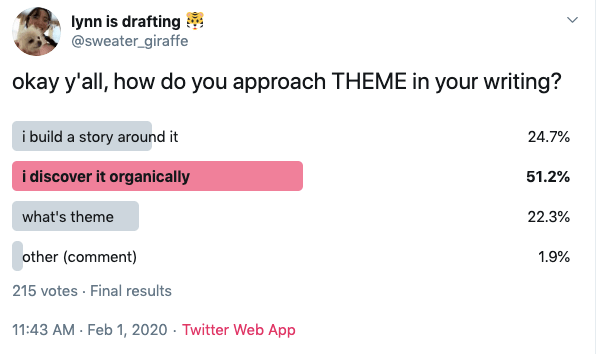
The majority of polled writers said they discover themes organically, through the process of crafting and writing their story. However, 22.3% also claimed to not know what theme was, at least not consciously. This is by no means a true reflection of the writing community as a whole, seeing that the blind nature of Twitter polls means there is no way to determine the accuracy of the results, but that’s a significant number.
My theory is that somewhere along the way, the Western public education system bamboozled entire generations of budding writers into hating theme. I certainly did when I was a teenager! When I started writing, and for an embarrassing number of years after, I entirely disregarded the existence of theme and its importance as a tool in any fiction writer’s arsenal. Throughout virtually every English class I took, I basically told myself that theme sucks, it’s boring, it’s made up, and no, the impending zombie horde is not a metaphor for the failings of the American healthcare system. Get to the good stuff, already.
But honestly, theme is so much more important than we writers can sometimes make it out to be. Even in genre fiction. Especially in genre fiction. Today, I’m going to go over why theme is critical to a good story and how to start approach theme in your own work. Please note that this is in no way meant to be a definitive approach to theme, and is mostly based off of my own experiences and observations.
an introduction to theme
Theme is a nebulous concept, and everyone seems to have a slightly different definition and approach. Personally, I’m a minimalist. Simply put: What is your story about?
By this, I don’t mean the elevator pitch or plot. Themes are, in short, the abstract concepts that a story naturally explores. They can be expressed through plot and setting, but are generally most evident in the form of characters and their arcs. This might be a bit difficult to grasp conceptually, so here’s an example.
THE LIGHTNING THIEF is about a young boy who discovers he is the son of a Greek god and must go on a quest to recover Zeus’ lightning bolt. However, it’s about identity, heroism, and friendship.
Now, try to imagine Percy Jackson’s journey without any of the themes mentioned above. See what I mean? Themes pull stories together, and also set them apart from one another. Every Marvel movie feels exactly the same because their themes are exactly the same—honor, duty, heroism, good vs. evil, et. al. That’s what makes them such good comfort food.
Now on the flip side, imagine if THE HOBBIT’S main theme was the power of romantic love. That’s a completely different story, with a completely different set of priorities and a whole new arc for Bilbo and… Smeagol? ??????? I don’t know. I have also never read or watched this.
what is a thematic statement?
Thematic statements are a bit trickier. They’re what your story has to say about the themes you explore. Sometimes the thematic statement can be a big moral message, Aesop-style: “Idleness brings want,” “Slow and steady wins the race.” However, the statement can also be something as simple as “Love is capable of causing great pain” or “Never trust a man who owns a pickup truck.” (Okay, probably not that last one, but you see my point.)
The problem with theme is that it’s actually a very easy concept to grasp, which tricks a lot of writers into thinking they’ve cracked it. However, this usually results in shoddy follow-through. In my humble opinion, it’s not enough for theme to be present—something has to be said to make the story worthwhile.
If you’ve ever finished a book or film and felt a lingering sense of dissatisfaction, 9/10 times it’s because the thematic statement was weak or lacking. This usually comes hand-in-hand with other faulty writing choices, like bad characterization or just a really dumb plot device, such as the abrupt reveal that the dead evil space wizard is not only alive, but sexually reproduced and now has a GRANDCHILD, who is the PROTAGONIST, who VERY OBVIOUSLY REPRESENTED THE IDEA THAT GREAT HEROES CAN COME FROM NOWHERE AND LINEAGE DOESN’T MATTER—I—Sorry, I don’t know what came over me.
Haha whatever movie that was sounds like garbage though.
Thematic statements are most prominently expressed through the actions and choices of the characters, and are often also stated outright in the text, like a thesis statement in an essay. Of course, if it’s not plastered up in big neon letters, there’s always the chance that the reader will take away an entirely different message—and that’s kind of the beauty of fiction.
but i’m a genre writer
If you think theme is something for hoity-toity literary fiction writers, think again! Theme is just as crucial to genre fiction as it is to literary fiction, and otherwise good genre work often falls apart at the seams when the writer isn’t cognizant of the themes of their work. Falling into the pit of “Oh, I’m writing kidlit/horror/romance/schlocky SFF so it doesn’t matter” is WHACK and you KNOW IT.
Besides, genre and theme are intrinsically linked. Good high fantasy always tackles massive themes, particularly ones that are relevant to the contemporary world—reframing these big questions in a new setting is half the point of fantasy. The various subgenres of scifi literally all exist because different writers had different themes in mind regarding the future and general existential dread and ennui.
Seriously. Thematic cohesion is important even if you’re a genre writer. Hell, masterfully wielding of theme is what sets good stories apart from great stories, and yes that applies to your fun genre book about demon slaying college kids, Lynn.
how i deal with them pesky themes
Like many of the people I polled, my approach to theme is usually pretty loose. I outline without much in mind other than the general plot and the characters and their arcs, then start to pull things together from there. It’s a lot of stop and start, but I find that trying to force theme onto something rarely works.
My current project, AS THE TIGER CALLS THE DAWN, was initially a four POV sprawling mess of book. I was caught up in wanting to explore the scale of the world and the dynamics these four characters had, but the story itself felt disjointed and odd, lacking focus. It wasn’t until the themes finally clicked into place—the strain of taking responsibility for your actions, even when it hurts, and how the weight of guilt can change the course of a life—that I realized what I had to do. Afterwards, the plot became more streamlined, the conflict more focused, and I cut out the one POV whose storyline, while coherent in terms of plot, didn’t make sense thematically.
This is how it usually goes for me. I work a project, explore it, and then eventually figure out how to tighten the knots and bring everything together. Unfortunately, my big breakthrough on theme prompted a fourth draft and a rewrite, but I’m burning through it at the speed of light because I understand the story now. I no longer feel directionless.
But then again, every story pans out a little differently for me. I’ll be excited to see how the next one develops. Nowadays I try to approach all the media I consume with theme in mind, trying to figure out how everything threads together on a thematic level. It’s good practice, but I’m not a lot of fun to watch movies and TV with anymore.
a brief note on real world consequences
While it’s basically impossible to fully control what readers take away from your work, it’s deeply important to be aware of what you’re saying in your story. You’re probably not a racist, but if you’re writing a story about heroic fantasy white people conquering foreign fairy lands with the intent of civilizing them, well. That’s probably not a good look.
(Of course, this also works in the opposite direction. For example, ALTERED CARBON’s author is a raging transphobe who wrote a decidedly transhumanist book. And don’t get me started on Ms. Jo, ugh.)
While nebulous, theme is a crucial piece of the storyteller’s toolkit. It shapes stories or breaks them, and at its root, theme is the reason we write. Although it can be difficult to master, it’s a worthwhile pursuit.
I hope this post was eye-opening for some of you, or at the very least interesting! I’ll see y’all in a couple weeks for my February Wrap-Up.
xx
twitter: @sweater_giraffe


 lynn d. jung
Leave a reply to lynndjung Cancel reply